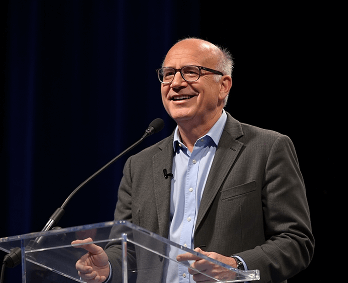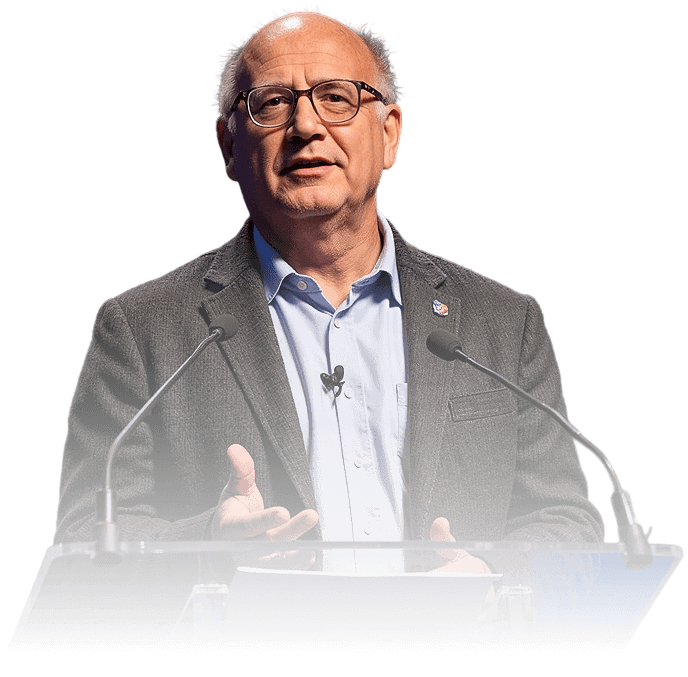
Michael Lissack, the President of the American Society for Cybernetics, founded a non-profit research institute (ISCE), launched an international PhD program in corporate anthropology, has written a half dozen books, been a successful Wall Street banker, and a candidate for public office. He has taught at a number of academic institutions in the US, Asia, and Europe, run ten international conferences on the topics of complexity, management, health care, experience, entanglement and ethics and founded a successful academic journal (E:CO). Worth Magazine recognized Dr. Lissack as one of "Wall Street's 25 Smartest Players" in 1999 and as one of the 100 Americans who have most influenced "how we think about money" in 2001. He generally is described as an applier philosopher and an entrepreneur.
Michael Lissack is available to speak about business ethics, the role of complex systems in the economy, whistleblowing, and applications of social complexity theory to organizations. Current videos here. ( click here for older videos)
My current work focuses on how complexity and emergence (the appearance and impact of the new) can be the bane of managers and their organizations. Emergence and ambiguity threaten to upset adherence to predefined categories, which is the groundwork for efficiency. Yet, the promotion of efficiency raises many ethical questions. The dangers of a thought system, where ideas and events are assigned to categories, the categories are labeled, and outliers are treated as statistical deviants,is the focus of social complexity theory
The Next Common Sense -- a webinar.
The State of the Economy -- an interview Dr. Lissack gave on Sky News Australia.
Complexity is the study of items which are more than just the sum of their identifiable parts. As we all learned in grade school: a dead frog is the sum of its parts while the living frog: it is complex.
My latest work on Complexity and Second Order Science can be found here. For related conference information click below.
Social Complexity is the study of complexity as it is experienced in groups and organizations.
Social Complexity Theory provides another perspective rooted in the felt experience of coherence and in the importance of emergence. Richard Rorty tells us, "Knowledge is not a matter of getting reality right, but rather a matter of acquiring habits of action for coping with reality." In common parlance such coping mechanisms are called "models." The aim of Dr. Lissack's research is to teach managers and members of organizations to make use of some very different Social Complexity Theory models as part of their coping mechanisms.
Ascribed Coherence (codes)
Ascribed, measured coherence focuses on how well a given item, person, situation etc. matches the assigned label. It also examines how well rule 'x' matches desired outcome 'y'. The underlying assumption is that the pairing of label 'x' and rule 'x' will produce desired outcome 'y'. Ascribed coherence is about codes and categories.
Resilient Coherence (cues, context, narrative)
Resilient coherence is what we experience when we piece together a narrative explanation of our present context based on the cues available to us and our beliefs about the future and the past. Resilent coherence is about how we have an ongoing willingness to act and the stories we tell ourselves to make sense of it all.
Certainty is a willingness to act. Applied ethics is about the choices we make which create that willingness.
Decisons lie at the heart of applied ethics. Critical questions of applied ethics for managers include:
How do I look at the world?
What values am I enacting/embodying?
What boundaries am I drawing to determine relevance?
What time frame am I considering?
What languaging and embodiment choices am I making?
The Institute for the Study of Coherence and Emergence (ISCE)
Coherence is regarded by many psychologists as critical to day to the day productivity and effectiveness of individuals. Both scholars and managers have adapted this belief to the world of management and organizations. Coherence is regarded as a sign of a well-run organization. But, the concept of a coherent thought defined as how well an idea holds together as a single entity gradually breaks down as the scale shifts to individuals, groups, and ultimately larger organizations.
Adapting to and dealing with emergence is perhaps the most important task facing managers and organizations. Coherence as traditionally defined interferes with that task. By restricting the concept of coherence to ascribed coherence managers and organizations implicitly are restricting their ability to deal with the unknown, the uncertain and the emergent. The research mission of ISCE is to explore how to expand that understanding to include resilient coherence. ISCE is online at isce.edu
ISCE has created a social action arm which focuses on Bullying, Sexual Assault, and Domestic Violence. These efforts are rooted in social complexity theory.
Arise in the Process of Sorting the Undifferentiated into the Complex and Attuned or the Simple and Ordered
"Atoms are not things, they are only tendencies. -- Werner Heisenberg"
"While most people understand first-order effects, few deal well with second- and third-order effects. Unfortunately, virtually everything interesting lies in fourth-order effects and beyond." -- Jay Forrester
I have founded a non-profit research institute (the Institute for the Study of Coherence and Emergence or ISCE), launched an international Ph.D. program in corporate anthropology, have written half dozen books, been a successful Wall Street banker, and a candidate for public office. I have taught at several academic institutions in the US, Europe and Asia, run ten international conferences on the topics of complexity, management, health care, entanglement, and ethics and founded a successful academic journal (E:CO). Worth Magazine recognized me as one of "Wall Street's 25 Smartest Players" in 1999 and as one of the 100 Americans who have most influenced "how we think about money" in 2001. I have founded/co-founded five technology startups and was the original angel investor for Tripod (one of two original "homepage builders") which we sold to Lycos for more than $300 million. Three of the other startups had great technology but were business failures (collectively losing more than $100 million). The learning experience was, of course, far greater from the failures.
Applied philosophy in the form of managerial/leadership ethics is a passion of mine. As a noted Wall Street whistleblower myself (and long before it was "fashionable"), I have had a focus on what can be done to better develop ethical instincts in the future leaders we are educating. I ran the ethics program at the Rotterdam School of Management. I have taught ethics at the Central European University, Vanderbilt, the George Washington University, Alaska Pacific University and presently at West Liberty University. I endowed a chair in Personal Ethics and Social Responsibility at Williams College. As an entrepreneur, leader of multiple non-profits, spokesperson for an academic discipline (cybernetics), candidate for public office, and thought leader, I bring a depth of personal experience which has both transformed and informed my approach to both the practice of ethics and how it is taught. I bring that approach to issues of management, leadership, innovation, entrepreneurship, and the philosophy of science.